

On Demand Webinars

Pre-recorded webinar with on-demand access for up to 3 months.
The way Autistic & ADHD children and young people communicate and play is often viewed from a deficit-based perspective. Therefore, intervention has traditionally been aimed at ‘correcting’ Neurodivergent play to be more aligned with sociocultural ‘norms’. This approach can be potentially harmful, as it teaches children and young people that their way of playing is 'wrong'. This can prevent them from freely participating in activities that bring joy and that they are passionate about.
Delivered by Anna Clarke (Psychologist and Play Therapist), this webinar promotes acceptance of Neurodivergent play, with focus on connecting with Autistic & ADHD children and young people through their own way of being. The content is suitable for teachers and therapists working with Autistic and ADHD children and young people. It is also relevant for parents and carers wanting to learn more about ways to connect with their Neurodivergent child.
Topics covered include:
Brief overview of Neurodiversity Affirming Movement and evidence base for children
Understanding Neurodivergent communication
Neurodivergent play
Seeking alone time vs social withdrawal? When to intervene
Inclusive play for all children
Teenagers and play
This is a 3 hour webinar with on-demand access available for up to 3 months.
From 1 December 2025, new professional standards come into effect for psychologists. A key focus is on how we gain informed consent, how we communicate, and how we adapt our processes to meet client needs.
This webinar is designed to educate on adapting communication for client needs.
Pre-recorded webinar with on-demand access for up to 3 months.
Delivered by Anna Clarke (Psychologist and Play Therapist)
General Information Webinar
Topics Covered Include:
Informed consent: understanding ongoing consent and shared decision making
How to adapt forms and processes for different communication needs
Supporting clients with neurodivergence, intellectual disability, or speech/language differences
Explaining therapy in clear, plain language so clients can understand. Including different approaches like EMDR therapy
Recognising power dynamics in the therapy room and how they impact consent
Strategies for children and young people (optional add-on session)
Working with Kids? Consider our BUNDLE webinar instead. General Information Session PLUS Adaptations for Working with Kids.
Who this webinar is for
Psychologists, provisional psychologists, counsellors, social workers, and allied health professionals
Suitable for early career and experienced practitioners alike
This webinar is for educational purposes only, and provides general communication support, and should not be construed as legal advice. This webinar is not a substitute for your own professional judgement or legal advice. This webinar does not take the place of core competencies.
Autistic and ADHD individuals face disproportionate risks of trauma, including physical, emotional, and sexual abuse, economic hardship, and social exclusion. Despite this, their trauma responses are often misunderstood, misdiagnosed, or overlooked — leading to delayed interventions and poor therapeutic outcomes.
This webinar is your chance to bridge the gap. Join Anna Clarke, Psychologist & Play Therapist, as they unpack the nuanced intersection of trauma and Neurodiversity. With evidence-based insights and actionable strategies, this session will empower you to provide truly Neurodiversity-affirming, trauma-informed care.
What You’ll Learn:
✅ Differential Diagnosis Formulation and how best to support your clients
✅ The overlap of trauma symptoms and misdiagnoses in Autistic and ADHD clients
✅ How to create trauma-informed case formulations that honor Neurodivergent experiences
✅ Practical, Neurodiversity-affirming techniques for treating trauma effectively
Why Invest?
During this 2 hour webinar, you’ll gain the tools and understanding needed to deliver better outcomes for Neurodivergent clients. With 3 months access to on-demand viewing, you can revisit these essential concepts at your convenience!
Be the psychologist who sees, understands, and empowers.
✨ Purchase this pre-recorded webinar today to advance your professional development.

Presented by Monique Mitchelson
Neurodivergent Clinical Psychologist, Co-Director of Divergent Futures, Author & Podcast Co-Host
In this rich, evidence-based webinar, Monique Mitchelson dives deep into the under-recognised connection between neurodivergence and chronic pain. Drawing on current research and clinical experience, Monique explores how sensory processing, interoception, and co-occurring conditions like ADHD can shape the experience of pain in Autistic and ADHD individuals.
You’ll learn:
Why Autistic children are almost twice as likely to experience chronic or recurrent pain
What the research says about pain perception differences in Autism and ADHD
The role of interoception and sensory sensitivity in how pain is experienced and expressed
How ADHD traits (e.g. impulsivity, difficulty pacing) can complicate pain management
Why traditional pain strategies often fall short for neurodivergent people
This webinar is for:
Psychologists, allied health, and medical professionals working with chronic pain
Autistic and ADHD individuals navigating pain or chronic illness
Support people, carers and family members wanting to better understand their loved ones
This 3-hour pre-recorded webinar is available to view on-demand for 90 days after purchase.
From 1 December 2025, new professional standards come into effect for psychologists. A key focus is on how we gain informed consent, how we communicate, and how we adapt our processes to meet client needs.
This webinar is designed to educate on adapting communication for client needs.
Pre-recorded webinar with on-demand access for up to 3 months.
Delivered by Anna Clarke (Psychologist and Play Therapist)
General Information Webinar
General Information Session available for individual purchase.
Topics Covered Include:
Informed consent: understanding ongoing consent and shared decision making
How to adapt forms and processes for different communication needs
Supporting clients with neurodivergence, intellectual disability, or speech/language differences
Explaining therapy in clear, plain language so clients can understand. Including different approaches like EMDR therapy
Recognising power dynamics in the therapy room and how they impact consent
Strategies for children and young people (optional add-on session)
Adaptations for Working with Kids Webinar
Add on only. This webinar is not available for single purchase.
Topics Covered Include:
Explaining therapy to kids
Using age-appropriate language and explanations
Communicating and collaborating with parents
Extra considerations for working with young people in therapy
Who these webinars are for
Psychologists, provisional psychologists, counsellors, social workers, and allied health professionals
Suitable for early career and experienced practitioners alike
This webinar is for educational purposes only, and provides general communication support, and should not be construed as legal advice. This webinar is not a substitute for your own professional judgement or legal advice. This webinar does not take the place of core competencies.
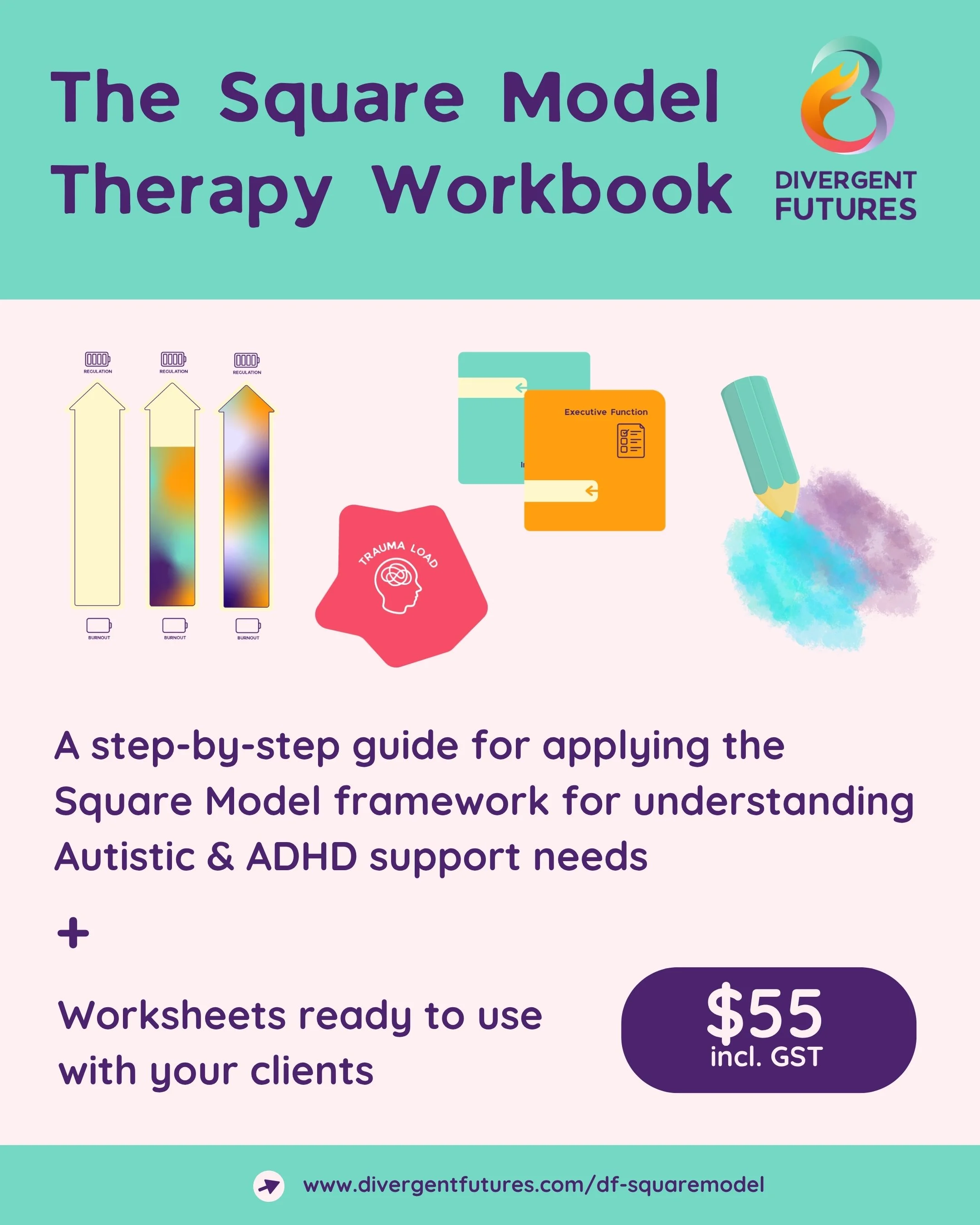
Co-authored by Autistic and ADHD psychologists Monique Mitchelson and Anna Clarke, co-directors of Divergent Futures.
This Therapy Workbook is designed for clinicians who have attended our Square Model: Neurodivergent Needs in Therapy training and are ready to apply the framework in case formulation and treatment planning for their clients.
What’s inside:
Detailed step-by-step guides on how to incorporate each element of the Square Model framework to honour the support needs of your Autistic & ADHD clients
Ready-to-use activities and therapy worksheets to be completed with your clients
Handouts designed to be shared with clients and colleagues
This Therapy Workbook is for:
Clinicians who attended one of The Square Model: Neurodivergent Needs in Therapy Webinars and are ready to incorporate everything they learned.
(Workbook for general audience coming soon!)
You will receive:
Fifty-eight-page digital workbook available to download immediately and ready to use.

Presented by Monique Mitchelson
Neurodivergent Clinical Psychologist, Co-Director of Divergent Futures, Author & Podcast Co-Host
Burnout in Autistic, ADHD and AuDHD individuals is misunderstood, mislabelled, and often missed in many clinical settings.
In this 3-hour pre-recorded webinar, Monique Mitchelson draws on current research, lived experience and clinical expertise to explore how neurodivergent burnout presents, what drives it, and supports to help reduce it.
You’ll learn:
What makes neurodivergent burnout different from general stress or depression
The specific factors that lead to burnout for Autistic, ADHD and AuDHD individuals
How masking, sensory overload, unmet needs and executive dysfunction increase burnout risk
Recovery strategies
This webinar is for:
Clinicians, therapists and health professionals seeking a deeper understanding of burnout in neurodivergent clients
Autistic, ADHD and AuDHD individuals
Support workers, educators, families and carers wanting to offer more informed support
This pre-recorded 3-hour webinar is available on-demand for 90 days after purchase.
All profits from the sale of this webinar go directly to the #TakeTheStand Campaign to support survivors of sexual assault.
On-demand professional development session
We understand that tackling topics like grooming, online safety and sextortion can feel challenging. Whether you’re aparent, psychologist, teacher or community leader working with children, we all have a part to play in protecting the young people in our community. Knowledge is power. So we’ve designed this webinar to provide you withpractical, actionable tools that won’t overwhelm you with trauma-heavy content.
This session is designed for professionals, carers, educators, and anyone supporting neurodivergent or marginalised people.
Led by psychologist and neurodivergent advocate Anna Clarke, the session walks through the stages of grooming, who is most at risk, and how to recognise patterns early. With a strong focus on trauma-informed care and neurodiversity-affirming practice, this training helps you respond with clarity and confidence.
What we’ll cover in this 2.5 hour session:
How to recognise and dismantle grooming behaviours to keep children safe
Insights into online safety and the growing risk of sextortion
Why Neurodivergent individuals, especially autistic people, are more vulnerable — and how to reduce their risk
Introduction to the Neurodiversity-Affirming Model — a powerful framework for building safer environments for neurodivergent children and young people
With professional guidance from Anna Clarke (Psychologist & Experienced DV/SA Support Service Member), this session focuses on prevention and proactive strategies. You’ll walk away feeling more knowledgeable and confident in your ability to:
Spot the warning signs early on
Support those at risk more effectively
Create safe, inclusive spaces that foster connection and protection for Neurodivergent individuals
Webinar available for 3 months from date of purchase.
Access Terms and Conditions of Purchase